A Bench or Moveable Chairs? Two Ways to Make a Square Restful
A bench or moveable chairs can shape how people pause in a public square. Compare permanence and flexibility to choose seating that fits its daily rhythms.
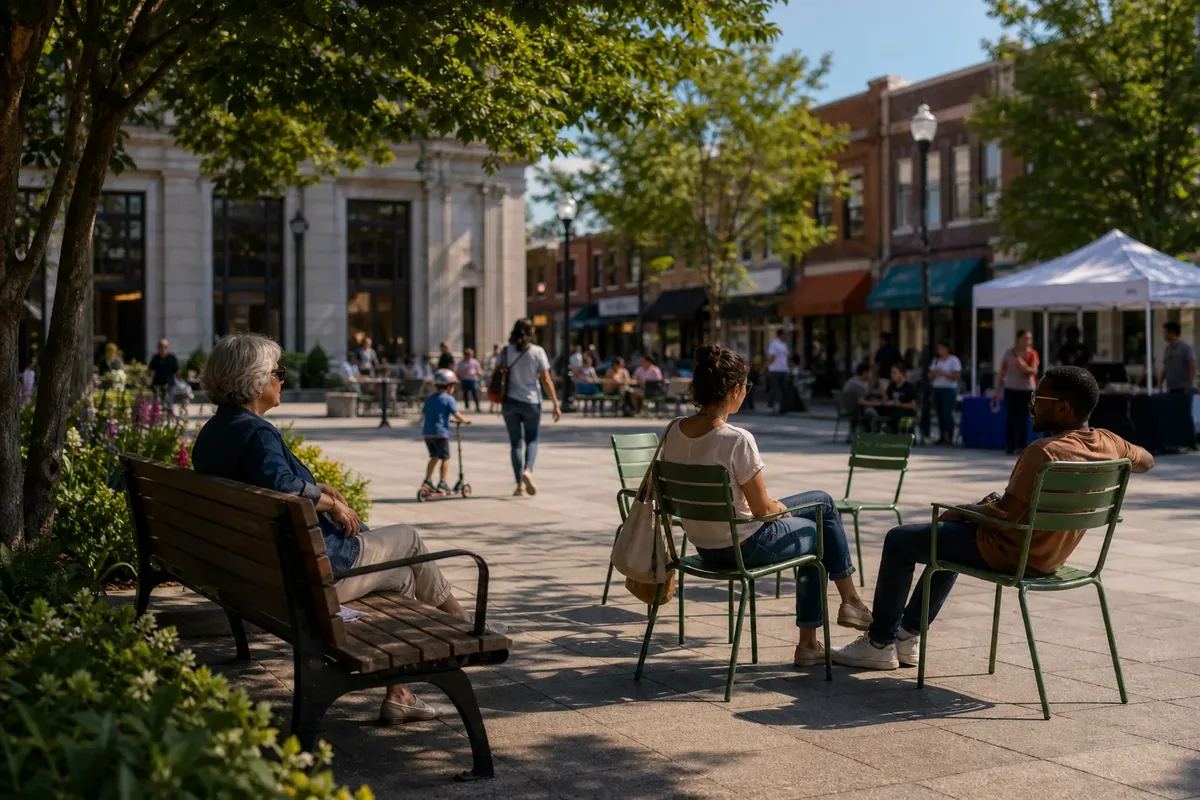
A bench or moveable chairs can make a public square feel restful, but they offer different kinds of choice. A bench gives people a dependable place to sit; chairs let them decide where to face, how close to sit, and whether to gather at all.
Imagine a hypothetical square beside a library and a row of neighborhood shops. A paved center hosts occasional events, while a shady edge catches people waiting for a friend or taking a break. The city is considering seating, and the choice is not simply between one object and another. It is between two ways of organizing public space.
The square’s daily pattern
Before choosing furniture, the city observes the square at different times and considers who uses it. In this invented situation, library visitors pause between errands, a parent waits while a child finishes an activity, and shop workers sit outside during a quiet break. On event days, the open center needs to stay clear.
These ordinary uses suggest two different needs: a reliable place to rest and room to adapt. A permanent bench can serve the first need without asking anyone to move furniture. Moveable chairs can serve the second, allowing visitors to turn toward a companion, a patch of shade, or the square’s activity.
The team also notes where people already stop. A seat placed beside a busy doorway may obstruct arrivals, while one tucked behind a planting bed may feel isolated. Seating works best when its position relates to the paths and edges people already use, rather than being treated as decoration for the center.
What a bench makes permanent
A bench establishes a clear, stable invitation: this is a place to sit. Its fixed position can give a square an anchor and make seating available without requiring users to arrange anything. A bench with a back and armrests can also offer more support than a simple chair, which matters to people who prefer a steadier seat.
That permanence shapes behavior. People can sit beside one another without having to negotiate a furniture layout, and a person arriving alone can occupy a defined spot. But a long bench may also make face-to-face conversation less natural. Its orientation directs attention toward one view, and strangers may feel uncertain about how much space to leave between them.
In the imagined square, the team considers a bench along the shady edge, set back from the main walking route. It would be available every day and leave the central paving open. The tradeoff is that it fixes the direction of sitting. Someone hoping to watch a street performer or talk with a friend might have to turn awkwardly or choose another place.
Materials and placement affect the experience, too. A seat exposed to full sun may be less inviting during hot weather; a spot near a shop entrance may become an obstacle. Those are reasons to think about shade, circulation, and the seat’s intended users before settling on a design, not reasons to assume any one bench will suit everyone.
What moveable chairs change
Moveable chairs make arrangement part of the public experience. One person can turn a chair toward the square, two people can face each other, and a small group can bring seats together without claiming a large, permanent area. The furniture gives visitors more control over their immediate surroundings.
That flexibility has limits. Chairs can drift into walking routes, cluster in ways that leave others out, or be moved away from a useful location. Staff may need to return them to a sensible starting arrangement. The chairs also need to be robust enough for public use, while remaining manageable for the people expected to reposition them.
In this hypothetical case, the team imagines a small set of movable chairs near the library-facing edge, with enough room between the seating area and the main route. During a quiet afternoon, a visitor could angle a chair toward the shade. If two neighbors wanted to talk, they could turn another chair toward it. For a public event, the chairs could be gathered outside the central activity area.
The expected observable result is not that every visitor will move a chair. It is that the square offers more than one usable arrangement. A person who prefers not to lift or reposition furniture can still sit, while others gain the option to adjust their view or company.
Choosing for this square
In the invented walk-through, the city does not treat the decision as an all-or-nothing contest. It places a fixed bench along the shady edge and uses a modest group of moveable chairs nearby. The bench provides a dependable resting point; the chairs let people create smaller social arrangements without occupying the event space.
This combination makes sense only because the square has distinct edges and a clear open center. A narrow plaza might not have room for loose chairs. A square used for frequent events may need a different approach from one that mainly serves as a quiet stopping place. The relevant question is what choices the layout leaves available on an ordinary day.
For this case, the team considers:
- Daily uses: Identify who pauses, meets, waits, or eats in the square, and when those activities occur.
- Walking routes: Keep seating out of the main paths and away from doorways where people need clear access.
- Orientation: Decide whether visitors should face a view, a companion, or the square’s shared activity.
- Support: Consider whether the seating needs backs, armrests, or a stable fixed option.
- Event space: Preserve room for gatherings without making everyday seating feel temporary or unwelcome.
- Care and upkeep: Consider who will monitor, clean, and reset moveable furniture as needed.
It is not worth trying to make every chair serve every possible group or activity. A crowded assortment of furniture can make a square harder to read and leave less room to move. A clear fixed seat plus a limited, thoughtfully placed set of chairs may offer more useful choice.
How should a square balance seats?
Are benches better for people sitting alone?
Not automatically, but a bench offers a predictable place that does not require arranging. A person sitting alone can choose a spot along its length, while the bench’s fixed orientation may not suit every view or preferred degree of privacy.
Do moveable chairs make a square more social?
They can make conversation easier because people may turn chairs toward one another. They also let someone sit apart or face outward, so the social effect depends on how many chairs are available and where they begin.
Can fixed and moveable seating work together?
Yes, if the square has enough space and a clear reason for each kind. A bench can provide dependable seating along an edge, while chairs allow flexible arrangements in a separate area.
Where should moveable chairs start?
Begin with a position near useful shade or an active edge, but outside the main walking line. The starting arrangement should make clear that the chairs belong in the square while leaving room for visitors to change their direction or grouping.
Let use shape the result
In the imagined square, a bench alone would provide reliable rest but fewer ways to adjust a visit. Chairs alone would offer flexibility but ask users and caretakers to manage more of the setting. The combined arrangement keeps one dependable place to pause and adds the option to sit differently.
That is the central lesson of the case: a bench or moveable chairs is a choice about how much of the square’s social arrangement should be fixed in advance. When considering a bench or moveable chairs for a public square, start with its everyday rhythms, then choose the furniture that supports those uses without taking away room to walk, gather, or simply sit quietly.
Nearby stories
Why a Sidewalk Corner Can Feel Easier to Cross
Why a sidewalk corner can feel easier to cross: learn to read curb shape, alignment, sightlines,…
From Market Edge to Meeting Place: The Changing Neighborhood Square
A changing neighborhood square can keep its shared role as stalls, errands, and gathering shift. Learn…